
Netflix’s “Senna” came out on Friday November 29. The six-episode miniseries was highly anticipated by Formula 1 fans, as it chronicles the life and career of legendary Brazilian driver Ayrton Senna.
The miniseries begins with Senna’s early days in karting and his move to England to race in Formula Ford, an entry-level feeder series for Formula 1. The story is split between his exploits on the track and his relationship with his then-girlfriend, Lillian.
Lillian follows Senna to England, and the couple eventually marry. Senna promises to race for a year before returning home to Brazil to work at his father’s company. He succeeds in Formula Ford and receives offers to move up the feeder-series ladder, but keeps his promise and returns home.
However, the racing bug does not leave him. Senna eventually returns to England after receiving an offer to race in British Formula 3. This costs him his marriage, but he finds success in Formula 3 and demonstrates the determination and confidence that would define his career.
Senna dominates the first half of the season but eventually finds himself in a close battle with Martin Brundle after Brundle’s team gains an engine advantage. Senna’s cause is hurt by his all-or-nothing driving style, which causes his equipment to fail and leaves him with zero points in several races. Ultimately, however, Senna holds on and wins the 1983 British F3 title.
Formula 1 Debut
Formula 1 team Lotus principal Peter Warr is interested in hiring Senna, but the team’s British sponsor wants a British driver—Nigel Mansell—instead. Senna receives offers to become a test driver from several teams, including McLaren, but ultimately signs with backmarker Toleman because it offers him a full-time race seat in Formula 1.
The miniseries does not spend much time on Senna’s one season at Toleman. He did not win a race with the team, but he scored three podiums and finished ninth in the championship.
The highlight of Senna’s Toleman stint—and rightfully so—is the 1984 Monaco Grand Prix. In heavy rain, Senna storms through the field and rapidly closes on race leader Alain Prost. He looks destined to score his first career victory, but FIA president Jean-Marie Balestre controversially stops the race.
Many people believed Balestre, a Frenchman, did so to help his fellow countryman Prost. Balestre would become a major villain in the miniseries, and this would not be the last controversy involving him.
Ironically, Prost ultimately lost the championship because the race was stopped. Since the race did not go the full distance, drivers received half points, meaning Prost received 4.5 points for second place. Had the race gone the full distance, Prost would have received six points for second and won the championship over teammate Niki Lauda.
Lotus
Senna moved to Lotus for the 1985 season. Lotus was no longer the championship-caliber team of its heyday, but it had finished third in the constructors’ standings in 1984, compared with Toleman’s seventh-place finish, so the move represented a significant upgrade.
The miniseries does not spend much time on Senna’s three seasons at Lotus. It covers his first victory, but not much else.
That is a shame because Senna’s Lotus career was impressive. He won six races, took 16 pole positions, and recorded 24 podiums in 48 races. He finished fourth, fourth, and third in the championship standings in 1985, 1986, and 1987, respectively, but never seriously challenged for the title.
As a result, Senna left for reigning champions McLaren-Honda before the 1988 season.
Senna vs. Prost
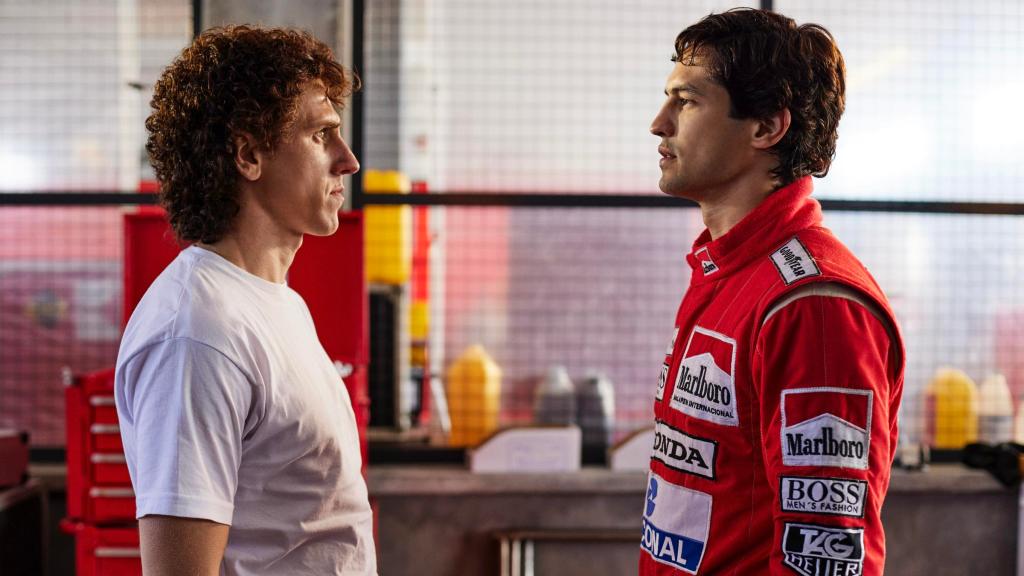
Now we get to the most exciting part of the Senna story: Senna versus Alain Prost, then a two-time world champion, as teammates at McLaren.
In 1988, McLaren won 15 of 16 races, with Senna accounting for eight of those victories. The only thing that prevented a complete season sweep was Senna crashing while attempting to lap another car.
The story focuses on Senna’s pursuit of his first championship, which began with a bang as he won seven of the first 11 races. However, he followed that stretch with finishes of 10th, sixth, and fourth, allowing Prost to close the gap heading into the penultimate race in Japan.
Senna won at Suzuka to seal the championship.
There is an important bit of context here: in 1988, F1 used a scoring system in which only a driver’s best 11 results counted toward the championship. Prost actually scored more points over the full season than Senna, although Senna was generally the faster of the two drivers.
The 1989 season saw McLaren-Honda remain dominant, but it was also the year Senna and Prost’s relationship deteriorated beyond repair.
It began with a dispute at Imola. The two drivers had agreed that neither would attempt to pass the other before Turn 3 at the start. There was no issue at the original start, but a restart took place after an incident. Senna passed Prost at the restart and argued that the agreement did not apply because it was technically a new start. Prost believed a restart was functionally the same as the original start.
At the urging of McLaren team principal Ron Dennis, Senna made amends with Prost internally. However, Prost gave an interview weeks later and made the entire incident public.
Needless to say, Senna was furious. Their relationship never recovered, and Prost signed with Ferrari a few months later.
Suzuka, 1989
The most memorable clash came at the Japanese Grand Prix, the penultimate race of the season. Both drivers were battling for the championship, but this time Prost had the advantage.
The two collided, and Prost abandoned his car. Senna, who needed to win to keep his championship hopes alive, had track personnel push his car back onto the circuit. He then had to pit to repair his damaged front wing.
Senna returned to the track five seconds behind the race leader with only four or five laps remaining. He nevertheless made up the gap and took the checkered flag.
However, while Senna was returning to the track, Prost made a beeline for the FIA president’s office. Balestre—who had earlier warned McLaren not to favor Senna over the departing Prost, a detail not included in the miniseries—disqualified Senna for cutting the chicane.
The decision was highly controversial. The alternative would have been for Senna to reverse into traffic, which arguably would have been even more dangerous. Moreover, Senna had not gained an advantage by cutting the chicane after the collision; he had crashed onto it and stalled.
The disqualification handed Prost his third world championship.
Across their two seasons together, Senna won 14 races to Prost’s 11 and held a 26-4 advantage in pole positions. Both won a championship. Prost outscored Senna in both seasons, but Senna was generally faster and finished ahead of Prost more often than not when both completed a race.
1990: Senna Gets His Revenge
In 1990, Prost was gone and Gerhard Berger became Senna’s teammate. Berger, a close friend of Senna’s, has only a minor role in the miniseries.
Once again, the championship came down to Japan, the penultimate race of the season. This time, Senna entered the race with the championship lead.
The drama began before the race. Pole position was located on the “dirty” side of the track, meaning it offered less grip and was therefore the slower starting position. Senna spoke with track marshals and asked them to reverse the grid positions so that the pole sitter would not be disadvantaged. They agreed.
Senna promptly took pole.
However, Balestre intervened and ordered that the pole sitter remain on the dirty side of the track. Senna was outraged, particularly given what had happened the previous year.
He decided that if Prost was ahead of him going into the first corner, neither of them would finish the race. When Prost got alongside him, Senna turned into his former teammate, sending both cars out of the race.
The result gave Senna his second world championship.
1991
In 1991, the miniseries focuses on Senna’s dramatic first victory in Brazil. It also spends considerable time on his relationship with Xuxa, a Brazilian television host and singer.
Ultimately, their relationship falters because Senna spent most of the year in Europe while Xuxa had her own touring schedule.
On the track, Senna wins his third—and ultimately final—world championship in 1991.
The Years That Get Glossed Over
There is not much about the 1992 and 1993 seasons in the miniseries.
It would have been good to see more about Senna battling the Williams-Renaults in inferior machinery. In 1993, for example, McLaren used customer Ford engines after Honda withdrew, and the customer engine was a specification or two behind the works Renault power unit.
Perhaps Senna’s most legendary performance came at Donington in 1993, but that race is not included in the series.
McLaren team principal Ron Dennis tells Senna that “the best driver wants the best car,” but that is about all the miniseries gives us regarding Senna’s eventual move from McLaren to Williams.
The show briefly touches on Senna considering leaving Formula 1, but does not explore that possibility in much depth.
Imola 1994
The final episode covers Senna’s brief time at Williams and focuses heavily on the events at Imola in 1994.
There is a poignant scene in which Dr. Sid Watkins asks Senna to retire following the death of Roland Ratzenberger.
The middle of the episode depicts the mourning in Brazil following Senna’s tragic death at the age of 34 after his crash at Imola.
Netflix does not end the series on that somber note, however. Instead, it closes with an inspirational message from Senna, career and life highlights set to Tina Turner’s “Simply the Best,” including footage of Senna attending one of Turner’s concerts.
The series also highlights the great work done by the Ayrton Senna Foundation on behalf of Brazilian children.
Actors and Actresses
Brazilian actor Gabriel Leone plays Senna, and I thought he did a great job. He had an incredibly difficult task but filled Senna’s shoes well. At times, he seemed almost like Senna himself.
The second-most important character is British actress Kaya Scodelario, who plays “Laura.”
Laura is a journalist whose career tracks Senna’s from Formula Ford all the way to Imola in 1994. She is a fictional character, but a useful one. She provides a way for the audience to gain insight into Senna’s thoughts while also showing how Senna was perceived by others at various points in his career.
For example, Laura introduces the prejudice against Latin Americans in 1980s Britain and the concerns surrounding Senna’s aggressive driving style in Formula 1.
Laura and Senna are not friends, but they are longtime colleagues who are generally cordial despite Laura occasionally angering Senna with her coverage.
The third character of note is French actor Matt Mella, who plays Alain Prost. He does a good job and, like Leone, effectively channels the personality of his character.

Portrayal of Alain Prost
Prost was portrayed as the bad guy in the 2010 documentary Senna, which is also available on Netflix.
He comes off better in the Senna vs. Prost book, although some readers argue that the book favors Prost. How Prost would be portrayed in the miniseries was therefore one of the big questions I had going in.
To some extent, Prost coming off badly is inevitable in a story in which Senna is the hero. But there is a lot of room between portraying Prost as the villain and portraying him as the hero.
I thought Prost came across as conniving and overly reliant on the FIA to bail him out. More importantly, I do not think the series gave him enough credit as a great driver in his own right.
The show could have done more to build Prost up as a worthy rival, give him more credit, and then show Senna narrowly beating him.
Still, Prost is humanized, and the miniseries ends with Prost and Senna having an amicable conversation. Senna even sends his regards to Prost while sitting in the car during a French television broadcast at Imola in 1994.
So, I think Prost comes off better here than he did in the documentary.
One touching moment that is missing, however, is from Prost’s final race, when Senna asks him to join him on the top step of the podium. As noted earlier, the 1992 and 1993 seasons are largely glossed over, so this omission is understandable but disappointing.
Michael Schumacher
I also wondered how Michael Schumacher would be portrayed.
Surprisingly, Schumacher does not appear other than being alongside Senna on the grid at Imola. He is mentioned a few times in connection with 1994, particularly Senna’s suspicion that Schumacher’s Benetton was using traction control, which had been banned before the 1994 season.
That is not a good look for Schumacher, but it is a fair part of the story because Senna genuinely believed the car was using an illegal system.
The context is important: Senna was trying to control a poorly handling Williams while staying ahead of the rising young Schumacher in what he believed was an illegal car.
Brazil
Senna’s connection to Brazil and Brazilian fans receives significant attention, especially toward the end of the miniseries.
Senna was deeply affected by the poverty he saw in Brazil and eventually created the Ayrton Senna Institute, which has helped millions of Brazilian children.
Interestingly, Alain Prost is on the foundation’s board. The documentary notes this, but the miniseries does not.
Other Sources on Senna
I would supplement the miniseries with the 2010 documentary Senna. It provides a more in-depth account of his career and offers a better look at Senna as an individual.
The documentary is more serious but less entertaining than the miniseries.
I also recommend the Senna vs. Prost book, which provides considerably more depth on both Senna’s and Prost’s careers. The book focuses primarily on the height of their rivalry from 1988 through 1990, but it also covers their rise through the sport and the later years of their careers.
Was Ayrton Senna the Greatest F1 Driver?
You can read my thoughts on this in my earlier F1 GOAT debate.
The short version is that Senna was probably the best and fastest F1 driver ever. However, it is difficult for me to call him the greatest because he lacks the longevity—and therefore the career statistics—of drivers such as Lewis Hamilton and Michael Schumacher. Senna’s career was tragically cut short at just 34 years old.
Conclusion
Despite not being perfect, Netflix did a great job with Senna. The series covers an enormous amount of ground in less than six hours and succeeds in making one of the most fascinating careers in Formula 1 accessible and entertaining.
There are certainly things I would have liked to see included—particularly more of Senna’s Lotus years, the 1992 and 1993 seasons, and his legendary 1993 Donington performance.
Still, those omissions do not undermine the overall production.
I recommend that all racing fans watch the series. It is an entertaining introduction to Senna’s life and career, and it works even better when supplemented with the documentary and Senna vs. Prost.


Leave a Reply